Vincent Benavides was the
son of the gaoler of Quirihue in the
district of Conception. He was a man of
ferocious manners, and had been guilty of
several murders. Upon the breaking out of
the revolutionary war, he entered the
patriot army as a private soldier; and was a
serjeant of grenadiers at the time of the
first Chilian revolution. He, however,
deserted to the Spaniards, and was taken
prisoner in their service, when they
sustained, on the plains of Maypo, on the
5th of April, 1818, that defeat which
decided their fortunes in that part of
America, and secured the independence of
Chili. Benavides, his brother, and some
other traitors to the Chilian cause, were
sentenced to death, and brought forth in the
Plaza, or public square of Santiago, in
order to be shot. Benavides, though terribly
wounded by the discharge, was not killed;
but he had the presence of mind to
counterfeit death in so perfect a manner,
that the imposture was not suspected. The
bodies of the traitors were not buried, but
dragged away to a distance, and there left
to be devoured by the gallinazos or
vultures. The serjeant who had the
superintendence of this part of the
ceremony, had a personal hatred to
Benavides, on account of that person having
murdered some of his relations; and, to
gratify his revenge, he drew his sword, and
gave the dead body, (as he thought,) a
severe gash in the side, as they were
dragging it along. The resolute Benavides
had fortitude to bear this also, without
flinching or even showing the least
indication of life; and one cannot help
regretting that so determined a power of
endurance had not been turned to a better
purpose.
Benavides lay like a dead man, in the
heap of carcasses, until it became dark; and
then, pierced with shot, and gashed by the
sword as he was, he crawled to a neighboring
cottage, the inhabitants of which received
him with the greatest kindness, and attended
him with the greatest care.
The daring ruffian, who knew the value of
his own talents and courage, being aware
that General San Martin was planning the
expedition to Peru, a service in which there
would be much of desperation and danger,
sent word to the General that he was alive,
and invited him to a secret conference at
midnight, in the same Plaza in which it was
believed Benavides had been shot. The signal
agreed upon, was, that they should strike
fire three times with their flints, as that
was not likely to be answered by any but the
proper party, and yet was not calculated to
awaken suspicion.
San Martin, alone, and provided with a
brace of pistols, met the desperado; and
after a long conference, it was agreed that
Benavides should, in the mean time, go out
against the Araucan Indians; but that he
should hold himself in readiness to proceed
to Peru, when the expedition suited.
Having procured the requisite passports,
he proceeded to Chili, where, having again
diverted the Chilians, he succeeded in
persuading the commander of the Spanish
troops, that he had force sufficient to
carry on the war against Chili; and the
commander in consequence retired to
Valdivia, and left Benavides commander of
the whole frontier on the Biobio.
Having thus cleared the coast of the
Spanish commander, he went over to the
Araucans, or rather, he formed a band of
armed robbers, who committed every cruelty,
and were guilty of every perfidy in the
south of Chili. Whereever Benavides came,
his footsteps were marked with blood, and
the old men, the women, and the children,
were butchered lest they should give notice
of his motions.
When he had rendered himself formidable
by land, he resolved to be equally powerful
upon the sea. He equipped a corsair, with
instructions to capture the vessels of all
nations; and as Araucan is directly opposite
the island of Santa Maria, where vessels put
in for refreshment, after having doubled
Cape Horn, his situation was well adapted
for his purpose. He was but too successful.
The first of his prizes was the American
ship Hero, which he took by surprise in the
night; the second, was the Herculia, a brig
belonging to the same country. While the
unconscious crew were proceeding, as usual,
to catch seals on this island, lying about
three leagues from the main land of Arauca,
an armed body of men rushed from the woods,
and overpowering them, tied their hands
behind them, and left them under a guard on
the beach. These were no other than the
pirates, who now took the Herculia's own
boats, and going on board, surprised the
captain and four of his crew, who had
remained to take care of the brig; and
having brought off the prisoners from the
beach, threw them all into the hold, closing
the hatches over them. They then tripped the
vessel's anchor, and sailing over in triumph
to Arauca, were received by Benavides, with
a salute of musketry fired under the Spanish
flag, which it was their chief's pleasure to
hoist on that day. In the course of the next
night, Benavides ordered the captain and his
crew to be removed to a house on shore, at
some distance from the town; then taking
them out, one by one, he stripped and
pillaged them of all they possessed,
threatening them the whole time with drawn
swords and loaded muskets. Next morning he
paid the prisoners a visit and ordered them
to the capital, called together the
principal people of the town, and desired
each to select one as a servant. The captain
and four others not happening to please the
fancy of any one, Benavides, after saying he
would himself take charge of the captain,
gave directions, on pain of instant death,
that some one should hold themselves
responsible for the other prisoners. Some
days after this they were called together,
and required to serve as soldiers in the
pirates army; an order to which they
consented, knowing well by what they had
already seen, that the consequence of
refusal would be fatal.
Benavides, though unquestionably a
ferocious savage, was, nevertheless, a man
of resource, full of activity, and of
considerable energy of character. He
converted the whale spears and harpoons into
lances for his cavalry, and halberts for his
sergeants; and out of the sails he made
trowsers for half of his army; the
carpenters he set to work making baggage
carts and repairing his boats; the armourers
he kept perpetually at work, mending
muskets, and making pikes; managing in this
way, to turn the skill of every one of his
prisoners to some useful account. He treated
the officers, too, not unkindly, allowed
them to live in his house, and was very
anxious on all occasions, to have their
advice respecting the equipment of his
troops.
Upon one occasion, when walking with the
captain of the Herculia, he remarked, that
his army was now almost complete in every
respect, except in one essential particular,
and it cut him, he said to the soul, to
think of such a deficiency; he had no
trumpets for his cavalry, and added, that it
was utterly impossible to make the fellows
believe themselves dragoons, unless they
heard a blast in their ears at every turn;
and neither men nor horses would ever do
their duty properly, if not roused to it by
the sound of a trumpet; in short he
declared, some device must be hit upon to
supply this equipment. The captain, willing
to ingratiate himself with the pirate, after
a little reflection, suggested to him, that
trumpets might easily be made of copper
sheets on the bottoms of the vessels he had
taken. "Very true," cried the delighted
chief, "how came I not to think of that
before?" Instantly all hands were employed
in ripping off the copper, and the armourers
being set to work under his personal
superintendence, the whole camp, before
night, resounded with the warlike blasts of
the cavalry.
The captain of the ship, who had given
him the brilliant idea of the copper
trumpets, had by these means, so far won
upon his good will and confidence, as to be
allowed a considerable range to walk on. He
of course, was always looking out for some
plan of escape, and at length an opportunity
occurring, he, with the mate of the Ocean,
and nine of his crew, seized two whale
boats, imprudently left on the banks of the
river, and rowed off. Before quitting the
shore, they took the precaution of staving
all the other boats, to prevent pursuit, and
accordingly, though their escape was
immediately discovered, they succeeded in
getting so much the start of the people whom
Benavides sent in pursuit of them, that they
reached St. Mary's Island in safety. Here
they caught several seals upon which they
subsisted very miserably till they reached
Valparaiso. It was in consequence of their
report of Benavides proceedings made to Sir
Thomas Hardy, the commander-in-chief, that
he deemed it proper to send a ship to rescue
if possible, the remaining unfortunate
captives at Arauca.
Benavides having manned the Herculia, it
suited the mate, (the captain and crew being
detained as hostages,) to sail with the brig
to Chili, and seek aid from the Spanish
governor. The Herculia returned with a
twenty-four pounder, two field-pieces,
eleven Spanish officers, and twenty
soldiers, together with the most flattering
letters and congratulations to the worthy
ally of his Most Catholic Majesty. Soon
after this he captured the Perseverance,
English whaler, and the American brig Ocean,
bound for Lima, with several thousand stand
of arms on board. The captain of the
Herculia, with the mate of the Ocean, and
several men, after suffering great
hardships, landed at Valparaiso, and gave
notice of the proceedings of Benavides; and
in consequence, Sir Thomas Hardy directed
Captain Hall to proceed to Arauca with the
convoy, to set the captives free, if
possible.
It was for the accomplishment of this
service that Capt. Hall sailed from
Valparaiso; and he called at Conception on
his way, in order to glean information
respecting the pirate. Here the Captain
ascertained that Benavides was between two
considerable bodies of Chilian force, on the
Chilian side of the Biobio, and one of those
bodies between him and the river.
Having to wait two days at Conception for
information, Captain Hall occupied them in
observing the place; the country he
describes as green and fertile, and having
none of the dry and desert character of the
environs of Valparaiso. Abundance of
vegetables, wood, and also coals, are found
on the shores of the bay.
On the 12th of October, the captain heard
of the defeat of Benavides, and his flight,
alone, across the Biobio into the Araucan
country; and also that two of the Americans
whom he had taken with him had made their
escape, and were on board the Chacabuco. As
these were the only persons who could give
Captain Hall information respecting the
prisoners of whom he was in quest, he set
out in search of the vessel, and after two
days' search, found her at anchor near the
island of Mocha. From thence he learned that
the captain of the Ocean, with several
English and American seamen had been left at
Arauca, when Benavides went on his
expedition, and he sailed for that place
immediately.
He was too late, however; the Chilian
forces had already made a successful attack,
and the Indians had fled, setting fire to
the town and the ships. The Indians, who
were in league with the Chilians, were every
way as wild as those who arrayed themselves
under Benavides. Capt. Hall, upon his return
to Conception, though dissuaded from it by
the governor, visited the Indian encampment.
When the captain and his associates
entered the courtyard, they observed a party
seated on the ground, round a great tub of
wine, who hailed their entrance with loud
shouts, or rather yells, and boisterously
demanded their business; to all appearance
very little pleased with the interruption.
The interpreter became alarmed, and wished
them to retire; but this the captain thought
imprudent, as each man had his long spear
close at hand, resting against the eaves of
the house. Had they attempted to escape they
must have been taken, and possibly
sacrificed, by these drunken savages. As
their best chance seemed to lie in treating
them without any show of distrust, they
advanced to the circle with a good humored
confidence, which appeased them
considerably. One of the party rose and
embraced them in the Indian fashion, which
they had learned from the gentlemen who had
been prisoners with Benavides. After this
ceremony they roared out to them to sit down
on the ground, and with the most boisterous
hospitality, insisted on their drinking with
them; a request which they cheerfully
complied with. Their anger soon vanished,
and was succeeded by mirth and satisfaction,
which speedily became as outrageous as their
displeasure had been at first. Seizing a
favorable opportunity, Captain Hall stated
his wish to have an interview with their
chief, upon which a message was sent to him;
but he did not think fit to show himself for
a considerable time, during which they
remained with the party round the tub, who
continued swilling their wine like so many
hogs. Their heads soon became affected, and
their obstreperous mirth increasing every
minute, the situation of the strangers
became by no means agreeable.
At length Peneleo's door opened, and the
chief made his appearance; he did not
condescend, however, to cross the threshold,
but leaned against the door post to prevent
falling, being by some degrees more drunk
than any of his people. A more finished
picture of a savage cannot be conceived. He
was a tall, broad shouldered man; with a
prodigiously large head, and a square-shaped
bloated face, from which peeped out two very
small eyes, partly hid by an immense
superfluity of black, coarse, oily, straight
hair, covering his cheeks, hanging over his
shoulders, and rendering his head somewhat
the shape and size of a bee-hive. Over his
shoulders was thrown a poncho of coarse
blanket stuff. He received them very
gruffly, and appeared irritated and sulky at
having been disturbed; he was still more
offended when he learned that they wished to
see his captive. They in vain endeavored to
explain their real views; but he grunted out
his answer in a tone and manner which showed
them plainly that he neither did, nor wished
to understand them.
Whilst in conversation with Peneleo, they
stole an occasional glance at his apartment.
By the side of the fire burning in the
middle of the floor, was seated a young
Indian woman, with long black hair reaching
to the ground; this, they conceived, could
be no other than one of the unfortunate
persons they were in search of; and they
were somewhat disappointed to observe, that
the lady was neither in tears, nor
apparently very miserable; they therefore
came away impressed with the unsentimental
idea, that the amiable Peneleo had already
made some impression on her young heart.
Two Indians, who were not so drunk as the
rest, followed them to the outside of the
court, and told them that several foreigners
had been taken by the Chilians in the battle
near Chilian, and were now safe. The
interpreter hinted to them that this was
probably invented by these cunning people,
on hearing their questions in the court; but
he advised them, as a matter of policy, to
give them each a piece of money, and to get
away as far as they could.
Captain Hall returned to Conception on
the 23d of October, reached Valparaiso on
the 26th, and in two weeks thereafter, the
men of whom he was in search, made their
appearance.
The bloody career of Benavides now drew
near to a close. The defeat on the Chilian
side of the Biobio, and the burning of
Arauca with the loss of his vessels, he
never recovered. At length, in the end of
December 1821, discovering the miserable
state to which he was reduced, he entreated
the Intendant of Conception, that he might
be received on giving himself up along with
his partisans. This generous chief accepted
his offer, and informed the supreme
government; but in the meantime Benavides
embarked in a launch, at the mouth of the
river Lebo, and fled, with the intention of
joining a division of the enemy's army,
which he supposed to be at some one of the
ports on the south coast of Peru. It was
indeed absurd to expect any good faith from
such an intriguer; for in his letters at
this time, he offered his services to Chili
and promised fidelity, while his real
intention was still to follow the enemy. He
finally left the unhappy province of
Conception, the theatre of so many miserable
scenes, overwhelmed with the misery which he
had caused, without ever recollecting that
it was in that province that he had first
drawn his breath.
His despair in the boat made his conduct
insupportable to those who accompanied him,
and they rejoiced when they were obliged to
put into the harbor of Topocalma in search
of water of which they had run short. He was
now arrested by some patriotic individuals.
From the notorious nature of his crimes,
alone, even the most impartial stranger
would have condemned him to the last
punishment; but the supreme government
wished to hear what he had to say for
himself, and ordered him to be tried
according to the laws. It appearing on his
trial that he had placed himself beyond the
laws of society, such punishment was awarded
him as any one of his crimes deserved. As a
pirate, he merited death, and as a destroyer
of whole towns, it became necessary to put
him to death in such a manner as might
satisfy outraged humanity, and terrify
others who should dare to imitate him. In
pursuance of the sentence passed upon him,
he was dragged from the prison in a pannier
tied to the tail of a mule, and was hanged
in the great square; his head and hands were
afterwards cut off, in order to their being
placed upon high poles, to point out the
places of his horrid crimes, Santa Juona,
Tarpellanca and Arauca.
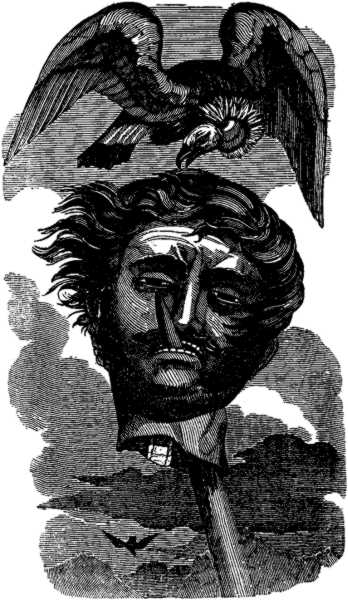
The head of Benavides stuck on a
pole.
 |